Stories
Office Coffee Programs in Malaysia: Complete 2026 Guide
Picture the office pantry on a Monday morning. A tub of 3-in-1 sachets on the shelf. A kettle. And in the corner, the dusty Nespresso machine that nobody refills. For years, that was office coffee in Malaysia.
Now the sachet is losing its shelf. Fresh-bean Auto-Barista machines, full-service coffee subscriptions and IoT-monitored kiosks are taking its place.
If you run HR, facilities or admin, the choice will land on your desk in 2026. Below are the costs, the models, the decision criteria and what to ask before you sign. The short version: count the cups before you count the ringgit.
The four office coffee models in Malaysia
1. Instant coffee (3-in-1 / 2-in-1 sachets)
Cost: RM 0.30–0.80
Setup: Hot water dispenser only
Best for: Small offices under 10 people, low-frequency drinkers
2. Capsule machines (Nespresso Professional, Lavazza, etc.)
Cost: RM 1.80–3.50
Setup: RM 2,000–8,000 machine + ongoing capsule purchase
Best for: Offices of 10–30, occasional client meetings
3. Auto-Barista / Coffee ATM (revenue share or subscription)
Cost: one monthly subscription, quoted after a free site survey
Setup: supplied, installed and serviced by the operator
Best for: Offices of 30+, hospitals, universities, transit hubs
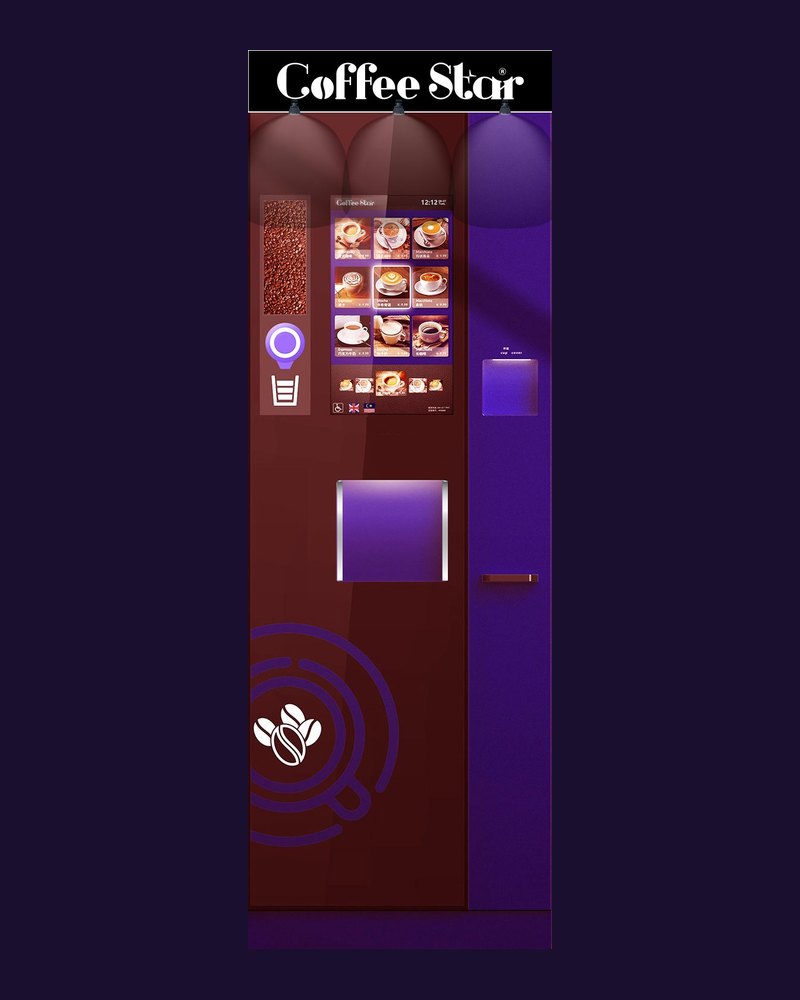
With a revenue-share arrangement like the Coffee Star Auto-Barista, the operator supplies, installs and services the machine. What arrives is specialty café-grade coffee from fresh beans and fresh milk, monitored over IoT and run as self-service. It does depend on footfall: the machine needs a minimum of 50+ cups a day to be commercially viable.
4. Full-service barista or staffed café partnership
Cost: RM 10–18
Setup: RM 150,000–500,000+ for outfit, staff, equipment
Best for: Premium HQs, large campuses, hotels
Cost comparison: 50-person office, 50 cups/day
| Model | Setup cost | Daily cost (50 cups) | Annual cost | Quality |
|---|---|---|---|---|
| 3-in-1 sachet | RM 200 | RM 25 | RM 9,125 | Basic |
| Capsule machine | RM 5,000 | RM 125 | RM 50,625 | Good |
| Auto-Barista (rev share) | Quoted after site survey | Variable | Quoted after site survey | Café-grade, fresh bean |
| Full barista café | RM 250,000 | RM 700 | RM 505,500 | Café-grade, staffed |
What HR, facilities, and admin teams should evaluate
- Daily footfall — Below 30 cups/day, instant or capsule wins. Above 50 cups/day, Auto-Barista becomes commercially viable
- Site requirements — Auto-Baristas need water connection, 16A single-phase power, drainage, ~1m² floor space
- Maintenance burden — Capsule machines need staff to refill water and empty grounds. Auto-Baristas with IoT monitoring handle this remotely
- Coffee provenance — Does it matter that the coffee is Fairtrade? Organic? (Coffee Star uses Fairtrade-certified Puro from Belgium Miko Koffie NV est. 1801)
- ESG alignment — Look for circular economy programmes (Coffee Star Bean2Blossom converts coffee grounds into compost). National Winner, SME ESG Challenge 2025/2026 (SME Corp Malaysia × UN Global Compact Network Malaysia, Brunei & Cambodia) for Bean2Blossom
- Sustainability reporting — IoT-monitored solutions provide auditable consumption data for ESG-mandated corporates
- Subsidy structure — Free staff coffee, subsidised, or full retail price? This determines model choice
Common questions Malaysian HR teams ask
Do we need to budget for a coffee programme? Not necessarily. In a revenue-share Auto-Barista deployment, staff and visitors pay per cup and the revenue is split between operator and host.
What if our office has fewer than 30 staff? Then a capsule machine is usually the right choice. Below ~30 daily cups the numbers favour capsules; a Coffee Star revenue-share Auto-Barista typically needs 50+ daily cups to be commercially viable.
Can we have non-dairy milk options? Yes. A modern Auto-Barista, Coffee Star’s machines included, can be configured with oat, soy or almond milk, depending on what the host prefers.
What is the response time if the machine breaks? With an IoT-connected machine like Coffee Star’s, the fault is detected automatically, and most issues are resolved remotely. When a technician is needed, a physical service visit is typically scheduled within 24–48 hours of detection.
Decision framework
- Less than 10 staff, occasional drinkers → 3-in-1 sachets + kettle
- 10–30 staff, mid-frequency → Capsule machine
- 30–100 staff with daily coffee culture → Auto-Barista revenue-share
- 100+ staff, premium HQ, ESG mandate → Auto-Barista revenue-share + ESG-aligned operator
- Hospitality / large campus / round-the-clock demand → Multiple Auto-Baristas + occasional human barista for events
How Coffee Star approaches office coffee
Coffee Star is a Malaysian smart coffee technology company whose team looks after 114+ IoT-connected Auto-Barista Machines across Peninsular Malaysia and Saudi Arabia. For a Malaysian office, the arrangement looks like this:
- Revenue-share model — staff and visitors pay per cup
- Fairtrade & Organic certified Puro coffee from Belgium Miko Koffie NV (est. 1801)
- IoT-monitored operation with predictive maintenance
- Bilingual interface (English + Bahasa Malaysia)
- Cashless payment via DuitNow QR, GrabPay, Touch’n Go, Boost, contactless cards
- Bean2Blossom integration — used coffee grounds collected for circular economy programme. National Winner, SME ESG Challenge 2025/2026 (SME Corp Malaysia × UN Global Compact Network Malaysia, Brunei & Cambodia) for Bean2Blossom
- UN Global Compact participant (UNGC ID 153705)
Want a site assessment for your office?
If your office, hospital, university or commercial premises in Malaysia receives 50+ daily visitors, you have already counted the cups. The next conversation is about what your pantry looks like on a Monday morning.
Email talktous@coffeestar.my with the subject “Office Coffee Site Assessment”, and include your location, staff count, current coffee setup and preferred timeline. The team replies within 2 business days.
Leave a Reply